Brownfield, Reborn: A Gentle New Chapter on the Village Edge
There’s something quietly hopeful about a brownfield site finding a new purpose. On the edge of a North Cornwall village, where the lanes narrow and the hedge banks rise, a work-in-progress plan is taking shape for a small, mixed development: eight houses in total, four for open market sale and four classed as affordable homes. It’s modest in scale, but in a county where the conversation about housing has become as much a part of everyday life as the weather, even small schemes can matter.
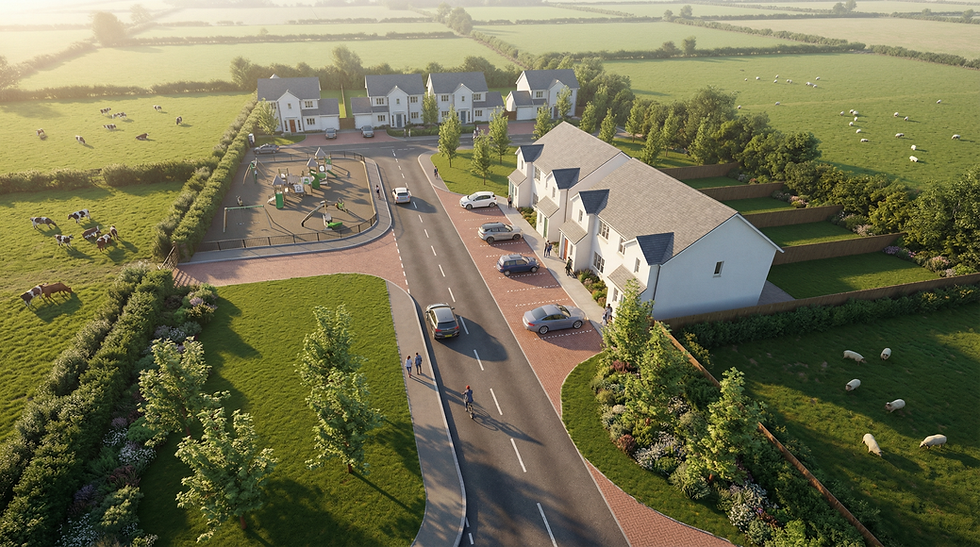
Brownfield land carries its own story. It’s the footprint of what came before—ground that has already done a turn for industry, storage or hardstanding, and can feel like a gap in the village fabric rather than countryside lost. Reusing it can be a gentler kind of growth, especially when the design pays attention to what makes North Cornwall feel like itself: a sense of shelter in the landscape, a respect for dark skies, the rhythm of Cornish walls and planting, and streets that don’t feel like they’ve been dropped in from anywhere else. Done well, a small cluster of homes can sit as a natural extension of the settlement—close enough to belong, yet mindful of the edges where village becomes field.
The reason schemes like this attract such interest is simple: Cornwall’s need for genuinely affordable housing is not abstract, it’s measurable, and it’s lived. Cornwall’s own Homechoice register has stood in the tens of thousands, with 23,720 households recorded on the register on 7 April 2025, a stark snapshot of demand compared to the limited number of lettings available each year. At the same time, the wider costs of simply living here keep rising. The ONS reported an average house price in Cornwall of £277,000 in December 2025, and average private rents of £1,004 in January 2026—figures that land hard in a place where wages often lag behind the national picture.
Ask almost any village shopkeeper, schoolteacher, care worker, hospitality manager or tradesperson and you’ll hear the same refrain: it’s not that people don’t want to live in Cornwall—people do—but too often they can’t secure a home that fits their income. When housing becomes out of reach, it doesn’t just affect individuals; it changes the feel of a place. Primary school rolls wobble. Employers struggle to recruit and retain staff. Young adults who grew up locally find themselves commuting long distances, sofa-surfing, or leaving the county entirely. Older residents may want to downsize but can’t find something suitable, leaving family homes “under-occupied” not by choice, but by lack of options. And the community life that makes a village a village—clubs, committees, the casual kindness of neighbours—gets thinner.
This is why affordable homes are so important, and why they’re not simply “cheaper houses”. In planning terms, affordable housing is designed to be accessible to people whose needs are not met by the market, and it’s usually controlled through legal agreements so the benefit stays with local people over time rather than vanishing in the next resale. In Cornwall, the pressure is compounded by the county’s popularity and the tug-of-war between homes as places to live and homes as assets or occasional retreats. Cornwall Council’s own housing intelligence has cited 13,140 second homes (from council tax base statistics, October 2023), a figure that underlines the scale of the challenge in some communities. The council has also moved to apply a 100% council tax premium on second homes from 1 April 2025, explicitly framed around the realities faced by places with constrained supply and high demand.
Within that bigger picture, a mixed development of four open market and four affordable homes can be a practical, balanced way to deliver what’s needed. The mechanics are often misunderstood. In many schemes, the open market houses help “make the numbers work” by contributing to the overall viability—effectively helping to cross-subsidise the affordable element, alongside any grant funding and the requirements secured through planning obligations. The affordable homes are typically delivered in partnership with a registered provider (a housing association), or sometimes through a community-led model, and then allocated using an agreed process—often with a strong local connection emphasis—so they serve the people the village depends on.
Cornwall’s own guidance for developers acknowledges that, particularly in rural settings, market housing may be supported where it is essential to deliver the affordable homes, and it sets clear parameters on the relationship between the two. A 50/50 split—four and four—speaks to that principle in a straightforward way: it’s mixed without being dominated by either tenure, and it can help a small site do more than it otherwise could.
What matters just as much as the numbers is how the homes feel on the ground. Mixed tenure works best when it’s indistinguishable in the everyday sense. Affordable homes shouldn’t be tucked away or built to a visibly different standard. In a good scheme, all eight houses belong to the same small “family”: similar materials, similar levels of detailing, the same relationship to the street, the same access to light, gardens and privacy. This isn’t only about fairness; it’s about cohesion. When neighbours share the same footpaths, the same bins day, the same view of the hedges turning in April, the development quickly becomes simply “the new bit of the village”, not a label.
There’s also a quieter benefit that is easy to overlook: small affordable schemes, especially on repurposed land, can help keep the local ecosystem of care and services alive. A village on the outskirts might be close enough to support a bus route and distant enough to need one; it might rely on a GP surgery that’s already stretched; it might depend on home carers travelling between clients, or on seasonal workers who would prefer not to live three towns away. Housing is the foundation that holds all of that up. Without it, the strain shows elsewhere—in health, in transport, in the stability of local businesses.
Of course, none of this means “build at any cost”. A brownfield redevelopment still has to answer the local questions properly: how it handles drainage in a county that knows sudden downpours; how it protects what biodiversity can be restored; how it manages traffic and safe access on rural lanes; how it respects the village edge rather than blurring it into suburban sprawl. But when a scheme is small, properly designed, and rooted in need, it can be an example of the kind of development that feels like a contribution rather than an imposition.
Cornwall has always been shaped by the relationship between land and livelihood. Today, that relationship is tested by affordability more than ever. Against that backdrop, eight houses on the outskirts of a North Cornwall village might not sound like a grand gesture, but it doesn’t need to be. Four open market homes and four affordable homes, on land already marked by previous use, is the sort of practical, locally tuned step that can help keep a community not just picturesque, but lived-in—by the people who make it work, season after season, year after year.


Comments